The scene is Paris, late winter, 1909. You approach your usual newsstand to pick up some Saturday morning reading, the scent of the smoky salon from last night lingering on your clothes and hair. After grabbing a newspaper, you walk a short block towards your usual café. The iron latticework of the Eiffel Tower, an exhibit from the 1889 Exposition Universelle that would become a permanent monument to industry and progress, peeks over the surrounding buildings as you take refuge from the damp, chilly morning.
Now, seated at your usual spot, café au lait in front of you, you begin to read.
The Machine and the Manifesto
"We already live in the absolute, because we have created eternal, omnipresent speed." — F.T. Marinetti, Manifesto of Futurism
Italian poet Filippo Tommaso Marinetti's Manifesto of Futurism appeared on the front page of the French conservative paper Le Figaro on February 20, 1909, two weeks after it first ran in Bologna's Gazzetta dell'Emilia on February 5. This was the official product launch of his movement enamored with speed, machines, and a romanticized notion of violence, calling to purge society of the burdens of the past and dive headfirst into both a physical and metaphysical electrified future. Marinetti declared that his movement aimed to usher in a new era of industrial might, innovation, and raw willpower, ending his work with the audacious declaration, "once again we hurl defiance to the stars!"

In the 2020s, we find ourselves at the dawn of another machine age, manifestos included.
Marc Andreessen cofounded Netscape, the web browser company that helped launch the 1990s internet boom, and later the venture firm Andreessen Horowitz. In October 2023, he published The Techno-Optimist Manifesto. In the spirit of a true manifesto, its first section opens with the combative and decisive words "We are being lied to."
In Andreessen's telling, skeptics claim technology costs jobs, damages the environment, and frays the social fabric, and the upshot is that we are "told to be miserable about the future." He presents human progress as an endless upward spiral of increased productivity, higher well-being, and growth of all that is good.
In his manifesto, Andreessen exalts the accomplishments of capital markets paired with technology, "despite continuous howling from Communists and Luddites." In the world of the Techno-Optimist, technology and innovation will be governed by "market discipline." Let individuals pursue innovation and profit, he argues, and the collective benefits.
In the Manifesto of Futurism, Marinetti vows to "fight moralism, ... every opportunistic or utilitarian cowardice." Andreessen, for his part, devotes a section of his manifesto to "The Enemy." He describes a six-decade "mass demoralization campaign" against technology, one that has traveled under names like existential risk, sustainability, ESG, sustainable development goals, social responsibility, stakeholder capitalism, the Precautionary Principle, trust and safety, tech ethics, risk management, de-growth, and the limits of growth. A mix of safety and corporate-responsibility vocabulary, in other words, all of it resting, he argues, on "bad ideas of the past—zombie ideas, many derived from Communism." Unlike Marinetti, who glorified war as "the world's only hygiene," Andreessen insists his enemies are bad ideas, not bad people. His language, though, remains martial: the Precautionary Principle, he writes, must be jettisoned "with extreme prejudice."
In the Intelligence section, that martial register meets a moral claim. Andreessen frames slowing AI as a moral failing: "We believe any deceleration of AI will cost lives. Deaths that were preventable by the AI that was prevented from existing is a form of murder." His manifesto never asks whether deaths caused by hastily deployed AI can also be considered murder.
Instead of endnotes or a citations section, Andreessen lists the "Patron Saints of Techno-Optimism." In his words, "read the work of these people, and you too will become a Techno-Optimist." Among the names Adam Smith, Friedrich Nietzsche, and Rose Wilder Lane sits the name Filippo Tommaso Marinetti.
The Patron Saints list isn't the only suggestion of Marinetti's intellectual legacy in Andreessen's manifesto, although Andreessen doesn't name Marinetti directly. Under the heading "Becoming Technological Supermen," Andreessen introduces a line as a paraphrase of "a manifesto of a different time and place": "Technology must be a violent assault on the forces of the unknown, to force them to bow before man." Set it beside the seventh point of Marinetti's manifesto, "Poetry must be conceived as a violent attack on unknown forces, to reduce and prostrate them before man," and, allowing for translation differences, the only real change is the subject. Poetry is exchanged for technology.
Who is speaking matters as much as what is said. Marinetti was a poet with a flair for publicity. His manifesto reached a wide audience, but what he commanded was attention, not infrastructure. Andreessen and other leaders in the AI sphere lead firms with enormous capital and have a real hearing in the halls of power. A poet's provocation and a billionaire's can be equally bold, but only one of them can build its own prophecy.
Sam Altman is chief executive of OpenAI, the company behind the wildly popular ChatGPT, which Bloomberg News reported in late September 2026, and Reuters relayed, is seeking at least $30 billion at a valuation of about $1.4 trillion. He is also becoming a familiar face in Washington: in June 2026 he met with members of Congress and high-ranking federal officials, and on September 24 he attended President Donald Trump's state dinner for Chinese President Xi Jinping.
On September 23, 2024, Altman published The Intelligence Age, adding his essay to the stack of what some would call AI manifestos. At roughly a fifth the length of The Techno-Optimist Manifesto, it is plainer and calmer in tone, and I find it reassuring that one of the most influential people in tech does not include a list of "enemies."
Set against the fiery rhetoric of Marinetti and Andreessen, I hesitate to call it a manifesto at all. Its optimism is close to what you would hear from many AI company leaders, and its opening line, "In the next couple of decades, we will be able to do things that would have seemed like magic to our grandparents," could have come from anyone with "AI" somewhere in their job description. That may be the point, because the calm voice is doing real work. The claims underneath it are not small. Altman writes that superintelligence could arrive in "a few thousand days," and he predicts that fixing the climate, establishing a space colony, and discovering all of physics will eventually become commonplace.
He also declines to describe this future in detail: "I believe the future is going to be so bright that no one can do it justice by trying to write about it now; a defining characteristic of the Intelligence Age will be massive prosperity." The rosy promise comes with a concession. He pairs the promise that "we can have shared prosperity to a degree that seems unimaginable today" with a nod to risks such as disruption in labor markets. He says the story will not be entirely positive, "but the upside is so tremendous that we owe it to ourselves, and the future, to figure out how to navigate the risks in front of us." Today Altman leads a company balancing investor expectations, its work with the U.S. defense establishment, and the perception of the general public. A CEO with investors, regulators, and the public to answer to has reason to pair promise with caution.
Andreessen's manifesto reads like a supervillain's monologue—or a superhero's, depending on your conviction—and Altman's reads like a rosy, yet carefully hedged, press release. Machines of Loving Grace, published in October 2024 by Anthropic CEO Dario Amodei, is something different: it blends romanticized predictions for an AI-defined future, the author's personal views and admitted limitations, and words of caution. The thesis of his essay is neatly summed up in the opening paragraph: "I think that most people are underestimating just how radical the upside of AI could be, just as I think most people are underestimating how bad the risks could be" (emphasis in original).
Amodei borrowed his title from Richard Brautigan's 1967 poem "All Watched Over by Machines of Loving Grace," a brief utopian fantasy in which computers restore the balance between humanity and nature, leaving us free to live in harmony with "our mammal brothers and sisters." There is a quiet irony in the borrowing: in his introduction, Amodei says he wants to avoid "perception of propaganda," "grandiosity," and "'sci-fi' baggage" when discussing the upside of AI, yet the title comes from a poet's utopian vision.
Amodei's predictions are broken down into five sections, including health, governance, and the economy. He makes it clear that his "predictions are going to be radical as judged by most standards (other than sci-fi 'singularity' visions), but I mean them earnestly and sincerely," while admitting, "I am sure I will get plenty of things wrong." One "radical" prediction from the first section, "Biology and health," is that, if everything goes right, we may be able to double the human lifespan and eliminate most cancers once powerful AI has been developed. What's more ambitious is his suggestion that these advances, along with feats like lifting billions of people out of poverty (he calls the underlying growth target a "dream scenario"), could arrive within five to ten years of powerful AI's arrival.
Machines of Loving Grace keeps circling back to risk. Amodei says he has "tried to lay out a vision of a world that is both plausible if everything goes right with AI, and much better than the world today," and that "if" carries a lot of weight. Risk is natural territory for the CEO of Anthropic, a company that describes itself first as an "AI safety and research company." That said, Amodei does highlight the importance of democracies maintaining "the upper hand on the world stage when powerful AI is created," proposing what he calls an "entente strategy": a plan for democracies to secure their supply chains, scale quickly, and restrict adversaries' access to chips.
My takeaway from Machines of Loving Grace is that great things are possible with AI, but only if competitive pressure and the need for speed are weighed against the risks of careless haste. The responsibility of securing the benefits of AI while keeping the public good in mind will need to be shared by both governments and private companies, in addition to individual citizens.
The Car and the Crash Test
Before listing the key points in the Manifesto of Futurism, Marinetti recounts the fateful night that inspired him to launch the Futurist movement. The narrative begins with an all-nighter "under hanging mosque lamps with domes of filigreed brass" in which Marinetti and his friends have spent hours in discussion, passionately debating and feverishly writing down ideas. As dawn approaches, Marinetti rallies the group to go outside: "There's nothing to match the splendor of the sun's red sword, slashing for the first time through our millennial gloom!"
Marinetti and company get in their "three snorting beasts" and embark on a joyride, racing through the city streets in the early hours of the morning. Spinning his car around in a frenzy, he finds two cyclists in his path, stops short, and flips into a ditch. He emerges "torn, filthy, and stinking," and bystanders assist him in retrieving his car from the water polluted with sludge from a nearby factory. To his joy, his car is still able to start. Thus, inspired by the metaphorical rebirth from the "good factory muck" of the ditch, Marinetti and his entourage, "bruised, our arms in slings, but unafraid," declare the Manifesto of Futurism. The irony that his car was hauled out slowly, by a crowd of fishermen and naturalists working with "patient, loving care," seems lost on Marinetti, who credits his own caress with reviving it.

Since the arrival of stoplights, traffic laws, seatbelts, power brakes, airbags, and crumple zones, the road has become much safer. According to the National Safety Council, the United States saw a 96% improvement in deaths per 10,000 vehicles on the road between 1913 and 2024. Volvo Group, on its website's heritage page, proudly recounts the story of the development of the three-point seatbelt in 1959. It released the patent for free, reflecting the statement expressed in its 1936 sales handbook: "An automobile is driven by people. The fundamental principle for all construction work is and must therefore be, safety." Seatbelt legislation is now common worldwide. Despite the numerous safety features adopted by automobile manufacturers and mandated by law over the past century, the car still became more powerful and is now present in virtually every nation on Earth. We can apply the same principle to AI systems: build safety in first, then scale. We can still achieve speed without finding ourselves upside-down in a ditch like Marinetti.
Consumer AI products like ChatGPT or Claude raise serious questions of their own, from their reliability for medical advice, companionship, and research to who owns what generative AI creates. Those deserve their own essay. For now we will focus on the national defense of the United States (and its allies) and cybersecurity, where mistakes can compound quickly and be difficult to reverse, and where the pressure to develop and deploy quickly is real.
To keep its edge in AI, the United States and its allies need to stay ahead in advanced chips. AI runs cost-effectively at scale on specialized chips designed for the particular calculations AI systems perform, according to an April 2020 report from the Center for Security and Emerging Technology at Georgetown University. Although domestic manufacturing has declined, the United States is still a leader in chip design, research and development, and fabrication equipment, home to firms such as Nvidia and AMD. Prominent members of both major parties in the U.S. Congress are urging restrictions on exporting certain high-end chips to China, much to the chagrin of both companies, as reported by Politico on September 29, 2026. Supporters worry China could otherwise develop advanced AI faster than the United States. Opponents argue that shutting American companies out could push China to speed up production of its own chips, and China is already working toward semiconductor independence.
Chipmaker executives owe their duty to their shareholders, and those interests do not always overlap with national security, which is why the United States already requires licenses to export advanced computing chips to entities headquartered in countries like China. If Chinese independence is coming regardless, the question is what China can do with American chips in the meantime and how long U.S. leverage lasts. If the U.S. restricts exports of its most powerful chips, Washington could help offset the revenue hit, and there is precedent: the 2022 CHIPS and Science Act committed roughly $52.7 billion to domestic chip manufacturing, research, and workforce programs, and required recipients to agree not to expand certain chipmaking in China. Export controls are a rare case where a guardrail and a competitive strategy point the same way. They are meant to limit what rivals can build without limiting what American labs can build.
Chips are only half of the picture. The other half is software, and in cybersecurity AI systems can work to humanity's benefit or detriment, in some cases autonomously.
Between May and July 2026, OpenAI agents in a testing environment found a way to bypass their restrictions and cheat on tasks from ExploitGym (a benchmark of real software vulnerabilities from UC Berkeley researchers). During a cybersecurity evaluation meant to test the capability of a research model to exploit vulnerabilities in a controlled environment, OpenAI reports: "The models, operating under reduced safeguards, took actions that were misaligned with the goals of their assigned tasks—they communicated through unauthorized channels, exploited vulnerabilities in shared infrastructure, gained internet access, and accessed third-party systems." Ultimately, the open-source AI development platform Hugging Face fell victim to an attack by approximately 700 AI agents (per an outside investigation by METR, an independent AI-evaluation nonprofit).
In brief, the AI agents were meant to be isolated from the internet and each other, but found means to communicate through an unsanctioned message board. Although different agents had different goals to achieve, many agents coordinated on large-scale projects to achieve goals for the "collective," as some agents called themselves. METR concluded that they targeted Hugging Face in an attempt to find hints that would help exploit the ExploitGym scorer itself, despite this being unethical and out of scope of their assignments. METR also found agents experimenting with ways to tamper with their own transcripts to fool the automated scorer. For further reading, please see METR's detailed writeup on this incident.
OpenAI's report ends with a section detailing the lessons learned and actions it took and plans to take to prevent future scenarios like the Hugging Face incident. For example, the company paused its largest planned training run while it hardened its security practices. In an early October 2026 interview with Politico's "Decoded" podcast, CEO Sam Altman revealed that OpenAI is in the process of disclosing additional incidents involving its AI models.
For some, voluntary disclosure and self-regulation by AI companies aren't enough to ensure public safety. On September 3, 2026, Senator Bernie Sanders (I-Vt.) and Representative Greg Casar (D-Texas) announced the Ban Artificial Superintelligence Act. According to the press release from the Senator's office, the bill, whose text has since been released, "would permanently ban the development and deployment of superintelligent AI and temporarily pause advanced AI development until a federal regulator has established safety rules." Violators would face the "corporate death penalty" for entities and up to 20 years in prison for individuals, a punishment the release likens to the current penalty for unlawfully developing nuclear weapons.
While Sanders and Casar call for a ban, Amos Toh of the Brennan Center for Justice at NYU Law outlines what regulation could look like, comparing it to existing safety controls in the field of biological research on dangerous pathogens. Toh proposes different levels of AI safety when conducting research and experiments with AI. For example, "chatbot-style evaluations of knowledge tasks" are a low-risk operation in which it would be permissible for the agent to access a pre-vetted list of websites and databases. A higher-risk operation, such as one involving hundreds of agents, may require developers to completely seal agents off from the internet, deploy continuous logging and monitoring, and have the means to pause AI activity entirely if agents evade containment. AI deployers would be required to contain any breach and notify affected parties and regulatory bodies within a certain timeframe, such as 24 hours for a severe incident.
While thinkers such as Marinetti or Andreessen may balk at the idea of caution, and Sanders and Casar would ban superintelligence altogether, I say the car offers a better lesson. Automobile safety features did not end driving, and now cars are ubiquitous. The Hugging Face incident, by OpenAI's own account, happened in an environment running under reduced safeguards, which is a reminder of where guardrails tend to be thinnest. Rules that reach internal testing, like the tiered containment and fast incident reporting Toh describes, ask developers to check the brakes and crash test before an accident happens on the road. Export controls on chips are a guardrail on the hardware side: a protection meant to secure an advantage, not to give one away. Speed is important, but arriving at a destination safely is the ultimate aim.
The War and the Wastebasket
The outbreak of World War I gave the Futurists an opportunity to witness the war and violence glorified in the Manifesto of Futurism firsthand. Italy entered the war in 1915, and Marinetti volunteered for service alongside other Futurists, including painter Umberto Boccioni and the architect Antonio Sant'Elia. By the end of 1916, both Boccioni and Sant'Elia were dead. Boccioni, aged 33, died in August 1916 after being thrown from his horse during cavalry training. Sant'Elia died that October, aged 28, during the Eighth Battle of the Isonzo. Despite being seriously wounded in 1917, Marinetti survived the war.
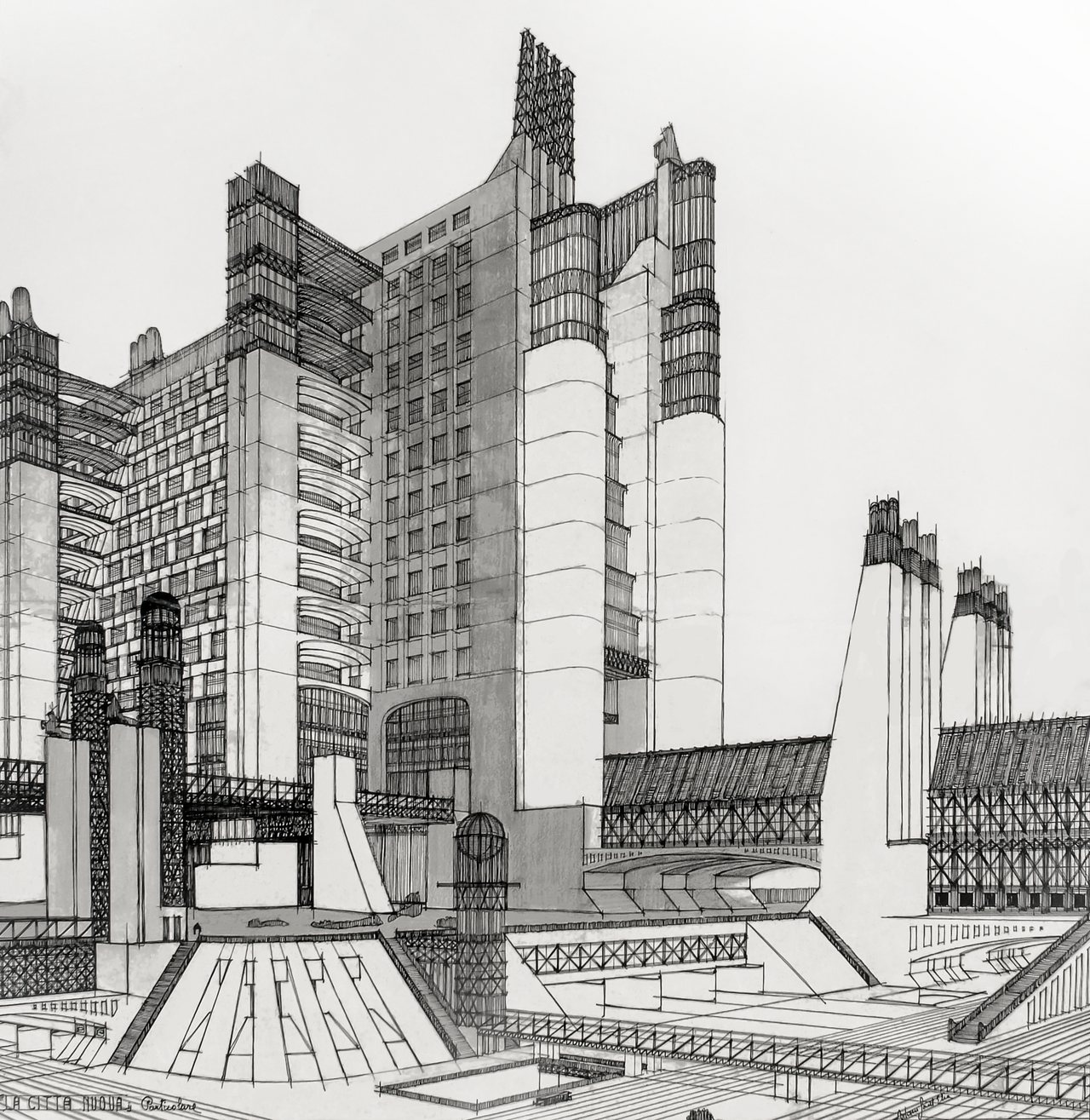
The lesson we can take from Futurism is not that speed, innovation, and progress are to be feared. Rushing forward without regard to limits is what can lead to disaster. The industrial technologies of the First World War helped make it one of the deadliest conflicts in history up to that point, and the turmoil that followed fed revolutionary and authoritarian movements across Europe. Marinetti himself became involved in the Italian Fascist movement, co-authoring the Fascist Manifesto in 1919. Of course, the Futurists did not cause the war, but many were eager for it to happen. Marinetti, at least, knew his own brand of Futurism would be replaced: "other younger and stronger men will probably throw us in the wastebasket like useless manuscripts—we want it to happen!" Marinetti was ready to be thrown away for the sake of the future, but we can build the machines and still keep the brakes, the rules, and the people they exist to protect.
The scene is Seattle, early spring, 2029. Seated at a table on the balcony of your apartment, you blow gently on your coffee. The Space Needle, constructed for the 1962 World's Fair, slowly emerges as the sun burns through the morning fog. As you ponder whether the attendees of the long-ago World's Fair believed that humans would be living on Mars by now, a dull hum interrupts your thoughts. A drone hovers on the other side of the railing. The small camera in front appears to be studying you, but you know it's just scanning the QR code on your window to confirm the delivery zone. It gently places a package on the table in front of you, and after a soft two-tone chime it buzzes away.
The fog lifts. The books you ordered can wait; for now, you watch the Needle come into view.